

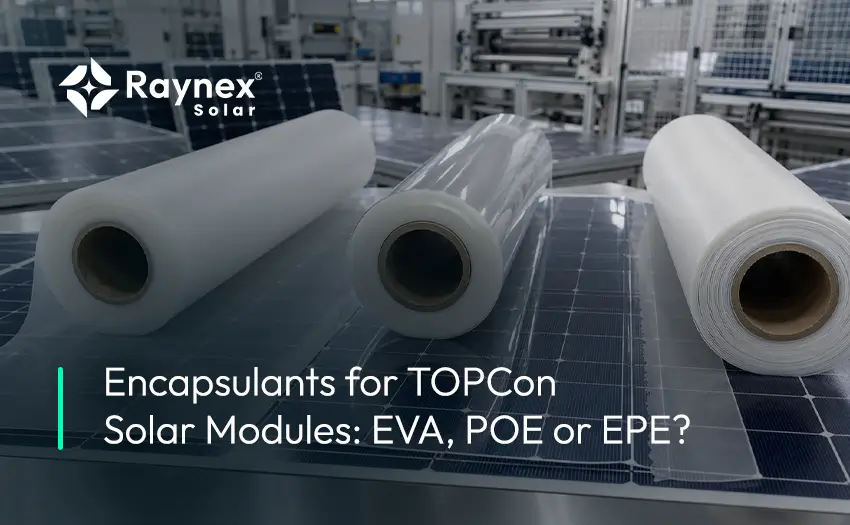
TOPCon modules need more careful encapsulant selection because the material around the cell has a direct role in moisture protection, electrical insulation and long-term stability.
EVA, POE and EPE are all used in solar module manufacturing, but they do not behave the same way during lamination or ageing. A material that works well in one module design may not be the right choice for another.
When selecting encapsulants for TOPCon solar modules, manufacturers should consider the module construction, production line and reliability target rather than the polymer name alone.
TOPCon stands for Tunnel Oxide Passivated Contact. It is an N-type cell technology used in high-efficiency solar modules. From the encapsulation side, the main concern is long-term protection of the cell and metallisation. Moisture, heat and electrical stress can affect sensitive interfaces inside the module, so the encapsulant becomes part of the reliability design.
A solar encapsulant has to provide several functions at the same time. It bonds the module stack, protects the cells, allows light transmission and provides electrical insulation.
For TOPCon modules, moisture protection becomes especially important. If moisture reaches the cell metallisation or interconnection areas, it can contribute to corrosion and power loss over time.
Electrical behaviour also matters. High volume resistivity and good PID resistance are important in module designs operating under higher system voltages.
Manufacturers therefore need to look beyond basic film transparency or initial adhesion. Water vapour transmission, ageing behaviour, lamination stability and interaction with the rest of the BOM all matter.
EVA is still attractive because most module factories already know how to process it. Lamination settings are familiar, adhesion is generally good and production teams have years of experience working with EVA films.
The limitation is moisture resistance. Conventional EVA usually has higher water vapour transmission than POE-based materials. During long exposure to heat and humidity, it can also form acetic acid, which may increase corrosion risk in some module designs. However, this does not mean EVA should be removed from TOPCon production completely.
A suitable EVA grade may still work where the film, cell, glass and other module materials have been properly qualified together. For some manufacturers, this can be a practical option if the required reliability is achieved without major changes to the production line.
POE is widely used where stronger moisture protection and electrical insulation are needed. Its lower moisture permeability helps limit water reaching sensitive parts of the module, while its high electrical resistivity supports PID resistance. These properties are useful in high-efficiency and bifacial N-type modules, which is why POE encapsulant for TOPCon has gained attention in recent years.
Processing, however, can be different from EVA. POE may need tighter control of storage, adhesion and lamination conditions. A factory changing from EVA to POE may need to adjust the process rather than simply replace one film with another.
Another point is formulation. Two POE films can have different additives, adhesion behaviour and ageing performance. The actual product data and test results are more useful than a broad “POE” specification.
EPE usually uses a co-extruded EVA/POE/EVA structure. The EVA outer layers support adhesion and familiar processing, while the POE core improves moisture-barrier and electrical performance. This makes EPE useful for manufacturers that want better moisture resistance but still prefer some of the handling and adhesion characteristics associated with EVA.
EPE is not identical across suppliers. Layer thickness, shrinkage, core chemistry and processing behaviour can vary. These differences can affect lamination and long-term module performance.
For TOPCon production, the actual multilayer design should therefore be checked before approval.
| Production Factor | EVA | POE | EPE |
|---|---|---|---|
| Lamination behaviour | Familiar to most lines | May need tighter control | Depends on multilayer design |
| Moisture barrier | Grade-dependent | Generally strong | Improved by POE core |
| Adhesion | Generally strong | Needs qualification | Supported by EVA outer layers |
| PID resistance | Grade-dependent | Often strong | Often strong |
| Process adjustment | Usually limited | May need optimization | Depends on formulation |
| Cost | Usually lower | Usually higher | Application-dependent |
On the production line, film behaviour matters as much as headline material properties. Shrinkage can affect layup and alignment. Peel strength is important for long-term bonding. Crosslinking or curing behaviour affects laminate quality, while a narrow solar module lamination process window can make process control more difficult. These points become more important when a line moves from trial production to higher daily output.
Yes. The rear-side construction changes how moisture moves through the module and how the encapsulant works with the rest of the stack.
Glass-glass modules use glass on both sides, which reduces moisture entry through the rear surface.
Moisture can still enter through the edges, so edge protection and long-term adhesion remain important. Bifacial glass-glass TOPCon modules also need good optical performance on both sides.
PID resistance, insulation and compatibility with the glass-glass stack should all be checked during qualification.
A glass-backsheet module uses a polymer backsheet on the rear side.
That backsheet becomes part of the moisture-barrier and electrical protection system. The encapsulant should therefore be evaluated together with the backsheet rather than as a separate component.
A material combination that works well in glass-glass construction may behave differently in a glass-backsheet module.
A technical datasheet is useful, but it should not be the only basis for approval.
Manufacturers should usually review:
The test setup should use the intended cell, glass, ribbon and backsheet wherever possible. This is especially important for TOPCon because degradation can come from interactions between materials, not only from the encapsulant itself.
A manufacturer already running a stable EVA process may prefer a TOPCon-suitable EVA grade if the required reliability can be achieved.
POE becomes more attractive when stronger moisture protection and electrical insulation are required.
EPE can be useful where the manufacturer wants improved barrier performance while retaining EVA outer layers for adhesion and processing.
The final decision should match the module architecture, expected operating conditions and production capability.
Raynex Solar manufactures EVA, POE and EPE encapsulant films for different PV module applications, including N-type module production. Material selection can be aligned with the required film thickness, module construction and lamination conditions.
Choosing encapsulants for TOPCon solar modules is not only a material-selection issue. It is also a production and reliability decision. EVA, POE and EPE each offer different advantages. The right choice depends on moisture protection, electrical performance, adhesion, processing behaviour and compatibility with the complete module stack. For manufacturers, testing the actual film in the intended BOM gives a much clearer answer than choosing by polymer type alone.
Yes. Some module designs use different encapsulants on the two sides depending on optical, moisture and electrical requirements.
They can. Temperature, vacuum time, curing behaviour and cycle time depend on the grade and should be validated on the production line.
Yes. Film thickness can influence flow, cushioning, optical performance and lamination quality.
Yes. A new encapsulant can change adhesion, PID behaviour, moisture response and interaction with other module materials.
They should review film thickness, shrinkage, optical transmission, peel strength, electrical properties, moisture-barrier data, ageing performance and recommended lamination conditions.