

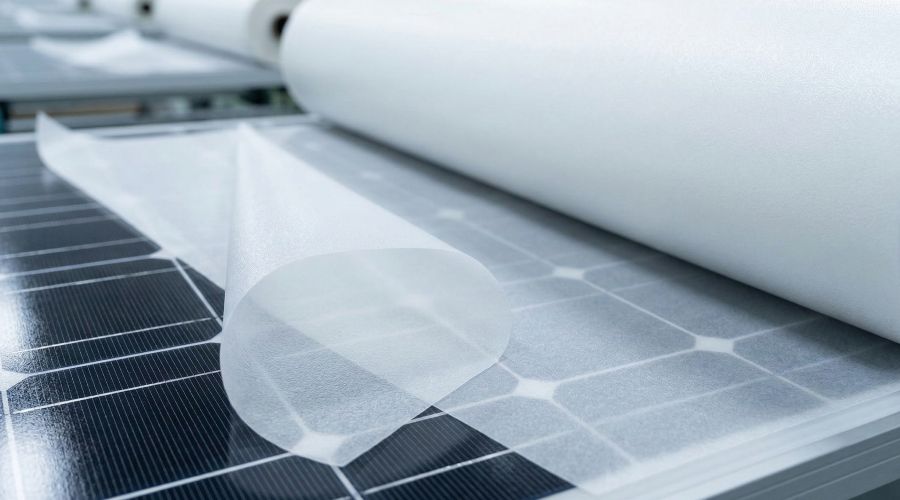
The full form of POE is Polyolefin Elastomer. Solar POE Encapsulant is a high-performance encapsulation film used in photovoltaic (PV) modules to protect solar cells from moisture, electrical leakage, and environmental stress.
Unlike conventional EVA, POE offers superior moisture barrier properties and enhanced PID resistance, making it ideal for advanced solar technologies such as bifacial modules and high-voltage systems.
During lamination, POE forms a durable and stable protective layer that improves long-term module reliability and performance.
| Property | Typical Value |
|---|---|
| Material | Polyolefin Elastomer (POE) |
| Thickness | 0.3 mm – 0.6 mm (customizable) |
| Light Transmittance | ≥ 90% |
| Water Vapor Transmission Rate | Very Low |
| Volume Resistivity | High |
| UV Resistance | Excellent |
| PID Resistance | Superior |
| Operating Temperature Range | -40°C to +85°C |
POE solar encapsulant film is a trusted choice for solar module manufacturing.
It is designed to support reliable production processes and meet the evolving needs of the solar industry.
Solar POE helps reduce potential induced degradation (PID) risks, improving the long-term reliability and performance of solar panels.
Bonds securely with glass and backsheet for structural stability.








Upgrade to Raynex Solar’s POE Encapsulant Sheet for superior durability, enhanced PID resistance, and long-term module performance.

POE means Polyolefin Elastomer. It is an encapsulant used in solar panels to make them more durable.
Yes, POE is highly recommended for bifacial and glass-to-glass modules due to its low moisture permeability and high durability.
Yes, POE solar encapsulant sheet provides superior protection against Potential Induced Degradation (PID), especially in high-voltage systems.
Yes, POE typically costs more than EVA, but it offers higher durability and long-term performance benefits.
Yes, POE is compatible with most modern solar module lamination systems, though parameters may vary slightly from EVA.