

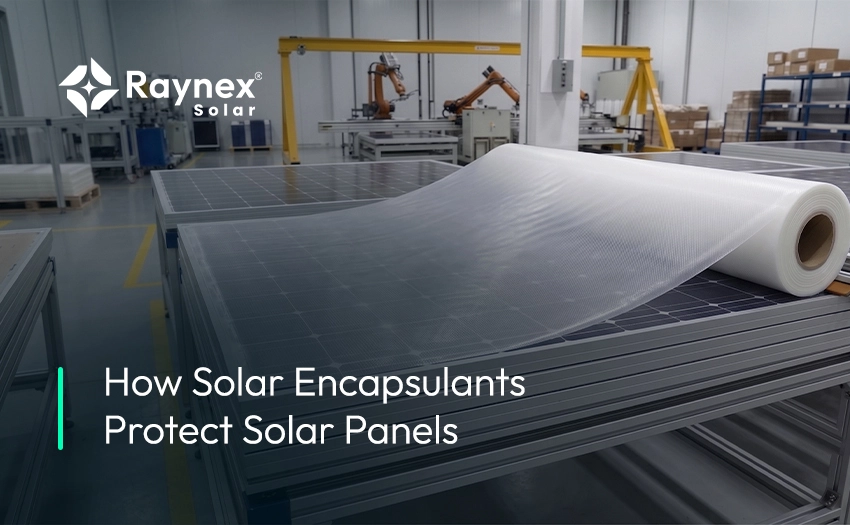
Solar panels are built to last for decades, but they face a lot of stress from the outside world. To keep the delicate solar cells safe, manufacturers use a special layer called a solar encapsulant. Think of it as a protective sandwich that keeps the cells from breaking. Without this layer, a solar panel would fail very quickly under the hot sun and heavy rain in India.
At Raynex Solar, we know that the quality of these materials makes a huge difference in how much energy your panels produce over time. Choosing the right solar panel protection material is the secret to a long-lasting solar system.
A solar encapsulant is a thin, glue-like sheet that wraps around the solar cells. During the manufacturing process, these sheets are placed on both sides of the cells. When the panel is heated up, the material melts and bonds the glass, the cells, and the back sheet together. This process is known as solar panel lamination.
These photovoltaic materials are usually made from plastics like Ethylene Vinyl Acetate (EVA) or Polyolefin (POE). Their main job is to provide PV module protection by creating a solid, airtight seal. This seal keeps the internal parts of the panel safe from the environment.
Solar cells are very thin and can crack easily. When wind blows hard or hail hits a panel, the cells could shatter. The PV module encapsulant acts like a cushion. It absorbs the shock from vibrations and physical impacts. This improves solar panel durability because it prevents the cells from moving or rubbing against each other, which could cause tiny cracks called micro-cracks.
Water is the biggest enemy of electronics. If moisture gets inside a solar panel, it can rust the metal parts that carry electricity. A high-quality EVA solar encapsulant or POE solar encapsulant acts as a waterproof shield. It blocks humidity from reaching the cells, which prevents corrosion and keeps the panel working efficiently for 25 years or more.
For a solar panel to work, sunlight must pass through the glass and the encapsulant to reach the cells. If the material turns cloudy or yellow, it blocks the light. Modern solar encapsulants are designed to be perfectly clear. They are also treated to resist UV rays from the sun so they don’t break down or lose their transparency over time.
Electricity needs to stay on its path. The encapsulant acts as an insulator, making sure power doesn’t leak out to the metal frame of the panel. Good materials provide high PID resistance (Potential Induced Degradation). Without this, a panel could lose up to 30% of its power because of electrical leaks caused by heat and moisture.
In the world of solar energy, the cells get all the credit, but the encapsulant does the hard work of holding everything together. It ensures the panel stays as a single, tough unit. This bond is vital for surviving the extreme heat in many parts of India. Without a strong bond, the layers of the panel could peel apart, which is a major failure.
When choosing PV module protection, manufacturers usually pick between EVA vs POE. EVA is the traditional choice because it is affordable and easy to use. However, POE is becoming more popular for high-efficiency panels because it handles moisture better and offers superior PID resistance.
| Feature | EVA Solar Encapsulant | POE Solar Encapsulant |
|---|---|---|
| Moisture Protection | Good | Excellent |
| Resistance to PID | Moderate | Very High |
| Cost | Lower | Higher |
| Flexibility | High | Moderate |
| Best Use | Standard Panels | Bifacial & High-Efficiency Panels |
If the encapsulant is low quality, you might see signs of trouble after a few years. One common sign is yellowing or browning, which means the material is burning under the sun. Another sign is delamination, where bubbles or peeling appear. If you see these, it means the solar panel durability is compromised, and the panel will produce less power.
As solar technology gets better, so do the materials. We are seeing new types of films that are even thinner and tougher. These materials help panels last even longer in harsh climates. At Raynex Solar, we stay at the forefront of these changes to ensure our customers get the best protection for their investment.
A solar encapsulant might be invisible, but it is one of the most important parts of a solar panel. It protects against moisture, vibrations, and electrical loss. Whether it is a standard EVA solar encapsulant or a high-performance POE solar encapsulant, these layers are what keep the lights on for decades. If you want a system that lasts, always check for high-quality photovoltaic materials in your modules.
Most high-quality solar encapsulants are designed to last for 25 to 30 years, matching the standard warranty of the solar panels themselves.
Yellowing means the encapsulant is degrading. While the panel might still work, its efficiency will drop because less light is reaching the solar cells.
POE (Polyolefin) is becoming popular because it has better water resistance and provides much higher PID resistance, which is essential for newer, high-efficiency bifacial solar panels.
No, once the encapsulant layers are laminated and sealed, they cannot be replaced or repaired. If the layer fails, the entire panel usually needs to be replaced.
Moisture can cause the layers to peel apart (delamination) and can lead to chemical reactions that create corrosion on the solar cells.