

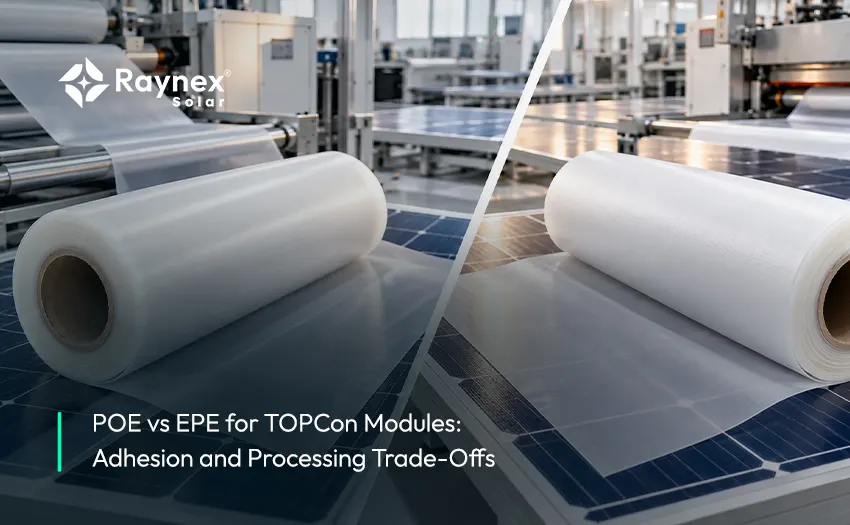
POE vs EPE for TOPCon solar panel manufacturing is an important material selection topic for PV module manufacturers working with N-type cell technology. The encapsulant must bond with the surrounding module layers, protect sensitive cell components, support electrical insulation, and withstand long-term outdoor exposure.
POE and EPE offer different material structures. POE uses a polyolefin elastomer film, while EPE uses an EVA-POE-EVA structure. EPE’s EVA outer layers can support adhesion, while its POE core contributes selected moisture-barrier and electrical properties. However, the actual results depend on the film formulation, module construction, and lamination process.
In this guide, we compare POE and EPE for TOPCon modules, with a focus on adhesion, processing requirements, moisture resistance, electrical properties, and production quality.
TOPCon stands for Tunnel Oxide Passivated Contact. This N-type cell technology uses a thin tunnel oxide and a passivated contact structure to reduce recombination losses and support high cell efficiency.
The encapsulant is one part of the complete PV module structure. It surrounds the cells and helps bond them to the front glass and the rear glass or backsheet. Its properties can affect the module’s optical transmission, electrical insulation, moisture control, and resistance to delamination.
For TOPCon module manufacturers, material selection should account for:
TOPCon cell technology alone does not determine the best encapsulant. Manufacturers should evaluate the complete module and validate the selected film using suitable test methods.
POE stands for polyolefin elastomer. POE encapsulant films are used in PV modules where moisture resistance and electrical properties are key material requirements.
POE films are commonly selected for their low water vapour transmission compared with many EVA formulations. This property can help limit moisture movement into the module, although edge sealing and other module materials also affect moisture protection.
POE grades can offer high electrical resistivity. This property is relevant when evaluating leakage-current pathways and PID risk in modules operating at elevated system voltages.
POE does not contain the EVA component associated with acetic acid release during certain ageing conditions. This can help avoid that particular degradation pathway, but it does not prevent every form of corrosion or material degradation.
POE may be considered for glass-to-glass and bifacial TOPCon modules when its optical, electrical, adhesion, and moisture-related properties meet the requirements of the full module design.
POE may suit TOPCon module designs where low moisture transmission and electrical insulation are key requirements. The choice should be based on the supplier’s technical data, compatibility checks, and module-level test results.
Explore Raynex Solar POE Encapsulant Sheets.
EPE is a three-layer encapsulant film made with EVA-POE-EVA construction. It places a POE core between two EVA outer layers.
This structure combines different polymers in one film. The EVA outer layers can support bonding, while the POE core contributes selected moisture-barrier and electrical properties. The final results depend on the quality and thickness of each layer, the formulation, and the lamination process.
EVA is widely used in PV modules because suitable formulations can bond well with compatible glass and other module materials. In EPE, the EVA outer layers may help meet adhesion requirements while the POE core serves a different role.
EPE gives manufacturers an alternative to a single-polymer POE film. The combination can be useful when a module design needs a balance of bonding, moisture control, and electrical properties.
EPE may be suitable for selected bifacial TOPCon modules if its optical transmission, electrical properties, adhesion, and moisture performance meet the module specifications.
Manufacturers can evaluate EPE alongside POE to compare peel strength, lamination behaviour, processing time, material usage, and finished-module reliability.
EPE may suit TOPCon module manufacturers who want EVA outer layers with a POE core. It should be considered when the layered construction meets adhesion, electrical, moisture, optical, and processing requirements.
Explore Raynex Solar EPE Encapsulant Sheets.
Adhesion is a key factor in PV module quality. The encapsulant must remain bonded to the glass, cell surfaces, and rear materials during lamination, transport, installation, and outdoor exposure.
EPE has EVA outer layers that may support adhesion to compatible surfaces. POE uses a single-polymer film, so its bonding behaviour depends on the grade and surface compatibility. This does not mean EPE always provides higher adhesion. A well-formulated POE film may meet the required adhesion level for a specific module design.
Manufacturers should assess the following factors:
A film should be selected using measured results from the intended module structure. Polymer type alone is not enough to predict the final bond strength.
Lamination converts the stacked module materials into a bonded structure. The correct process settings depend on the encapsulant formulation, equipment, film thickness, module design, and production target.
EVA-based films often use a controlled crosslinking process. POE and EPE products may have different processing requirements, so manufacturers should follow the supplier’s recommended settings for each grade. Cycle time should not be compared using temperature alone. Vacuum duration, heating profile, curing behaviour, module thickness, and cooling conditions can affect the total cycle.
Vacuum helps remove trapped air during lamination. Incorrect settings or poor material handling may contribute to bubbles, voids, or other laminate defects. Manufacturers should validate vacuum levels and timing using their actual equipment. Film storage, cleanliness, and handling also matter.
Many EVA encapsulants rely on crosslinking to achieve their required final properties. Some EPE products also include crosslinkable EVA layers. POE processing requirements vary by formulation, so the supplier’s technical instructions should be followed. Where applicable, manufacturers should monitor suitable process indicators, such as gel content, alongside visual inspection and adhesion tests.
Before changing from one film type to another, manufacturers should conduct controlled trials. Record lamination settings, cycle time, material usage, scrap rates, peel strength, and relevant module test results. This approach helps determine whether a change in encapsulant affects production output or finished-module quality.
| Parameter | POE Encapsulant | EPE Encapsulant |
|---|---|---|
| Film structure | POE-based film | EVA-POE-EVA layers |
| Adhesion | Depends on grade and surface compatibility | EVA outer layers may support adhesion |
| Moisture transmission | Commonly low | Depends on the POE core and full film structure |
| Electrical resistivity | Often high | Depends on the POE core and overall formulation |
| PID considerations | Often considered for PID-sensitive module designs | May also be considered for such designs |
| Lamination settings | Must be validated for the selected grade | Must be validated for the layered film |
| EVA-related ageing factors | Does not contain EVA | Contains EVA outer layers |
| Processing assessment | Review adhesion, cycle time, and quality data | Review layer compatibility, adhesion, cycle time, and quality data |
| Cost assessment | Compare product price and production data | Compare product price and production data |
| Selection basis | Full module specifications and test results | Full module specifications and test results |
This table provides general guidance rather than a universal ranking. The actual differences must be confirmed using technical data from the specific POE and EPE products being compared.
Identify the cell type, glass configuration, rear layer, system voltage, and intended operating conditions. The requirements of a glass-to-glass bifacial module may differ from those of a glass-backsheet module.
Request peel-strength data and confirm the test method. Check adhesion to the actual materials used in the production line, and review results after relevant ageing tests.
Compare water vapour transmission, electrical resistivity, and relevant PID test results. These properties should be considered with edge sealing, glass, cell technology, and other module components.
Use supplier guidance to set temperature, vacuum, cycle time, and curing conditions where applicable. Run production trials before introducing the material at full scale.
Review material cost, cycle time, yield, scrap rates, quality checks, and reliability requirements. The lowest price per sheet may not produce the lowest total manufacturing cost.
Use suitable reliability tests for the intended application. Depending on the module design, these may include damp heat, thermal cycling, UV exposure, adhesion checks, and PID testing.
Review product specifications, batch consistency, storage instructions, technical support, and delivery requirements. Consistent incoming material helps support repeatable production.
For related production guidance, read Solar Module Lamination Problems and How to Fix Them.
POE and EPE offer different options for TOPCon solar panel manufacturing. POE is often selected for its moisture-barrier and electrical properties, while EPE combines EVA outer layers with a POE core. The best choice depends on adhesion requirements, module construction, lamination conditions, ageing performance, and total production cost.
For reliable material selection, manufacturers should compare product-specific data, run controlled lamination trials, and validate the finished module. Raynex Solar offers POE and EPE encapsulant sheets for PV module manufacturers evaluating materials for their production needs.
Neither is best for every TOPCon module. POE may suit designs that prioritise low moisture transmission and electrical properties. EPE may suit designs that benefit from EVA outer layers and a POE core. The decision should be based on product data, processing trials, and module-level tests.
EPE’s EVA outer layers may support adhesion to compatible surfaces. However, the result depends on the film formulation, surface condition, lamination settings, and test method. Compare measured peel strength rather than relying on the material name.
POE’s electrical properties can help manage PID risk in suitable module designs. However, PID also depends on cell construction, module materials, system voltage, moisture, and operating conditions. Testing the complete module is necessary.
There is no single setting that applies to every POE or EPE product. Follow the supplier’s technical instructions and validate temperature, vacuum, cycle time, and curing requirements on the intended production equipment.
EPE may be used in bifacial TOPCon modules when its optical transmission, adhesion, moisture-barrier, and electrical properties meet the module requirements. The completed module should be tested for the intended operating conditions.
Manufacturers should use a suitable peel-strength method on the relevant material interfaces. They should also assess adhesion after applicable ageing tests and inspect the laminate for bubbles, voids, and delamination.
Request a technical data sheet, product specifications, storage instructions, recommended lamination settings, batch-quality information, and relevant test reports. Confirm that the data applies to the exact film grade being considered.