

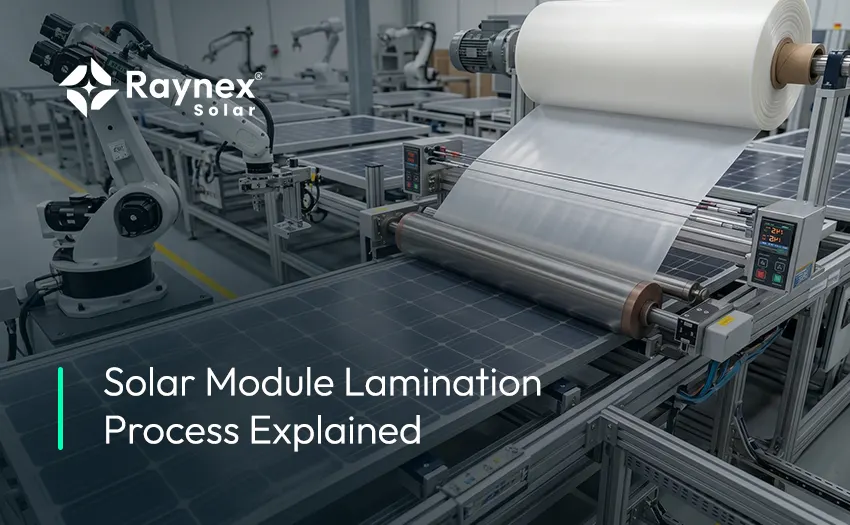
Have you ever wondered how solar panels survive heavy rain, scorching heat, and dusty winds for over 25 years? The secret isn’t just the glass on top; it is the Solar Module Lamination Process. At raynexsolar, we know that a solar panel is only as good as the seal that holds it together. As a leading Solar Company in India, we specialize in providing the materials that make this possible.
In this guide, we will break down the solar module manufacturing process explained simply so you can understand how these energy-makers are built to last.
The solar module manufacturing process has many stages, but lamination is one of the most important. In simple terms, it’s like making a high-tech sandwich. The PV module lamination process brings together all the different layers of a solar panel the front glass, the solar cells, and the backsheet and bonds them into one strong, weatherproof unit. This is done using a special film called an encapsulant. Through heat and pressure, the film melts and seals everything tightly, protecting the sensitive cells from air, moisture, and dust.
The main goal of the PV module lamination process is protection. Solar cells are very thin and can break easily. Without proper lamination, moisture would get inside, causing the metal parts to rust. By using the solar module lamination process, manufacturers ensure that the cells are held tightly in place, keeping them safe from vibrations, dust, and humidity. This is what allows panels to survive outdoors for decades.
To get the best results, you need the right ingredients. The best material used in solar panel lamination is typically Ethylene Vinyl Acetate, often called EVA.
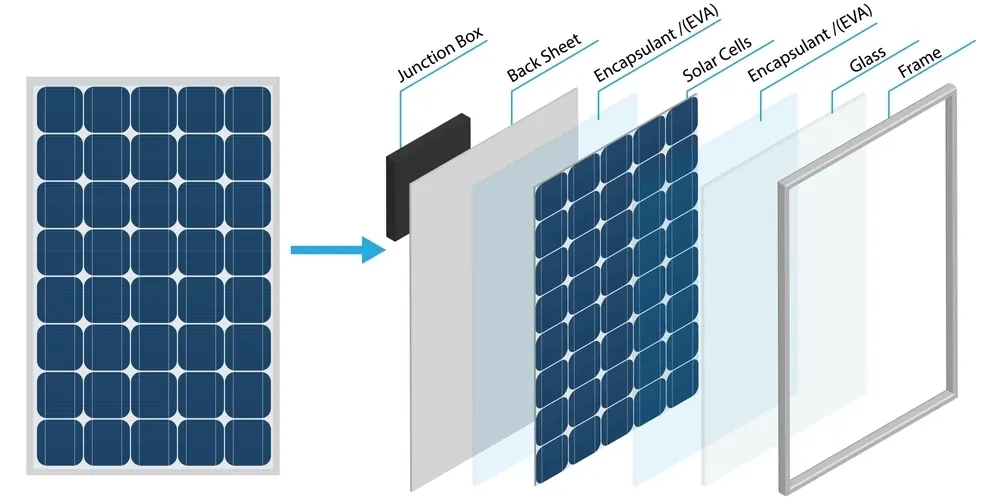
Building a solar pv module involves a very specific step by step solar module lamination process. Here is how it happens on the factory floor:
You might hear people talk about Solar EVE or EVA when discussing panels. Knowing how solar panels are laminated using EVA film is essential for quality control. The EVA acts as the “glue”, the “buffer” and a shock absorber. It protects the cells from vibration and prevents moisture from causing rust. Solar EPE or EVA materials must be high-grade to prevent yellowing over time.
At Raynex solar, we specialize in high-Quality EVA encapsulant sheets because we know that the durability of the entire module depends on this single layer. If the EVA is poor, the panel won’t last long in the harsh Indian climate.
Even with a great solar module lamination machine working, things can go wrong if the materials are poor. Common issues include:
Using high-Quality EVA encapsulant sheets and following the correct solar module lamination temperature and process helps avoid these costly mistakes.
Once the solar EVA lamination process is complete, these modules are ready for use across India. They are installed on home rooftops in cities, large solar farms in sunny states, and solar-powered water pumps in rural villages. Thanks to strong lamination, they can withstand India’s diverse climate — from humid monsoons in the south and east to extreme heat and dust in the north and west.
The solar module lamination process is the most critical step in making a solar panel that lasts. By choosing the right materials and following a careful step by step solar module lamination process, manufacturers can ensure high performance. At Raynex solar, we are proud to provide the industry with top-tier encapsulation solutions.
Are you looking for the best materials for your solar production? Contact us today to see how our EVA and POE sheets can power your success!
The ideal temperature usually ranges between 140°C and 150°C. This allows the EVA film to melt and cure properly, creating a permanent bond between the layers.
A typical cycle in a solar module lamination machine takes about 15 to 20 minutes, including the vacuum, heating, and cooling stages.
EVA film is used because it provides excellent light transmission, sticks well to glass and cells, and protects the panel from moisture and physical shocks.
Usually, if delamination occurs, it is very difficult to repair. It is better to prevent this by using High-Quality EVA Encapsulant Sheets during the initial manufacturing process.
Yes. If bubbles or moisture get inside due to poor lamination, it can cause corrosion and yellowing, which significantly reduces the energy output over time.
While EVA is the standard, POE (Polyolefin Elastomer) offers even better moisture resistance and is often used for high-efficiency bifacial solar modules.