

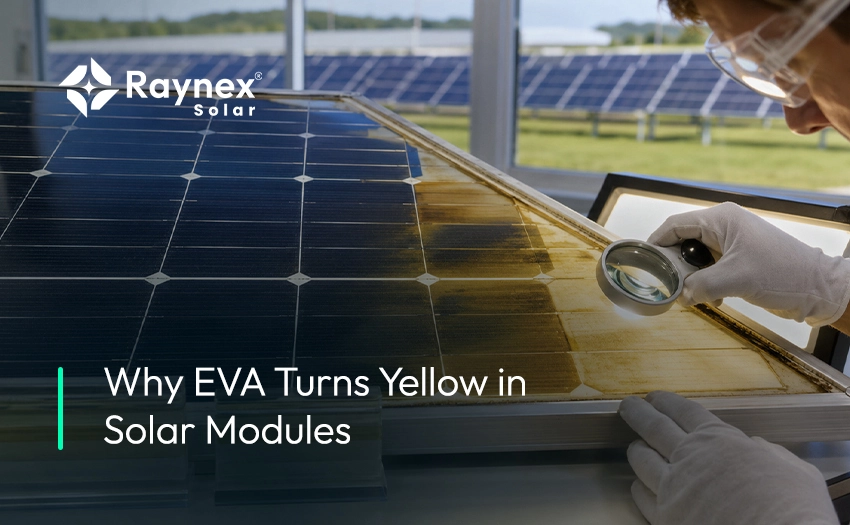
EVA encapsulant is designed to remain transparent so sunlight can pass through to the solar cells. But after long-term outdoor exposure, some modules develop yellow or brown areas inside the encapsulation layer.
This change is not always just visual. When EVA loses transparency, it can reduce the amount of light reaching the cells and may indicate that the encapsulant has started to degrade. Understanding why EVA turns yellow in solar modules can help manufacturers identify the factors that influence encapsulant colour stability and maintain long-term module performance.
Raynex Solar manufactures EVA, POE and EPE solar encapsulant sheets for PV module production. In EVA-based modules, yellowing is usually linked to a combination of UV exposure, heat, material formulation and processing conditions rather than one single cause.
EVA yellowing in solar modules is a gradual change in the encapsulant from clear to yellow. In more severe cases, the material may become dark yellow or brown.
The discoloration develops within the encapsulation system. It should not be confused with dirt or staining on the outer glass surface.
As EVA ages, changes can occur in the polymer and in the additives used to protect it. These changes may create compounds that absorb more visible light, which gives the encapsulant a yellow or brown appearance.
The severity can vary between modules and even between different areas of the same module.
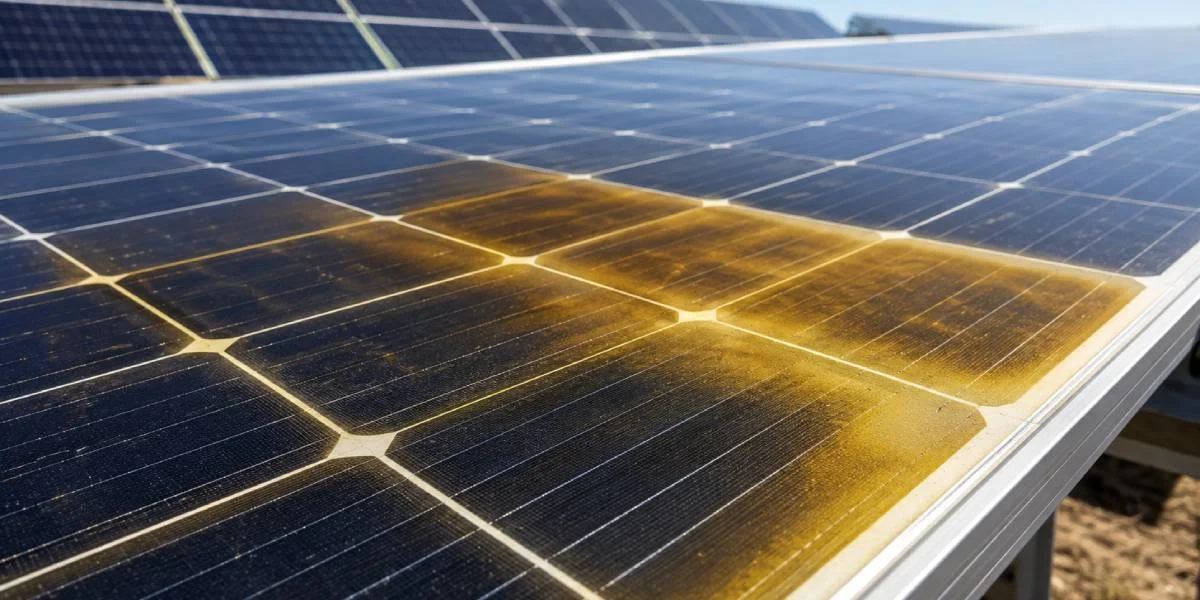
Understanding why EVA turns yellow in solar modules requires looking at several factors, including UV exposure, heat, EVA formulation and lamination conditions.Several factors can contribute to EVA encapsulant degradation. The most important are long-term UV exposure and elevated temperature, but formulation and lamination history also matter.
Solar modules remain exposed to sunlight for years, so UV radiation is one of the main stresses acting on the encapsulant.
This helps explain why EVA turns yellow in solar modules after long periods of outdoor exposure.
EVA formulations usually include UV absorbers and stabilizers to slow down degradation. Over time, however, these protective additives can change or become less effective.
At the same time, the polymer itself may undergo chemical changes. Some of the compounds formed during this aging process absorb visible light, which gradually changes the appearance of the EVA.
This is why UV degradation of EVA is closely associated with yellowing and browning in field-aged modules.
Modules can operate at temperatures much higher than the surrounding air, especially under strong sunlight.
Heat accelerates many chemical reactions inside polymer materials. When high temperature acts together with UV exposure, the aging process can become faster.
This combined UV and thermal stress is one reason EVA discoloration may be more noticeable in modules operating for long periods in hot, high-irradiance environments.
Not all EVA grades respond to outdoor exposure in exactly the same way.
A solar EVA formulation contains more than the base polymer. It may include UV absorbers, antioxidants, stabilizers, crosslinking agents and other additives that influence processing and long-term performance.
The balance of these components affects how the encapsulant behaves during curing and how well it maintains transparency after years of exposure.
For module manufacturers, this means initial optical clarity alone is not enough when qualifying an EVA material. Long-term stability also needs to be considered.
Lamination conditions can influence the final properties of EVA and are an important part of the solar module lamination process.
Each encapsulant grade has a recommended process window for temperature, vacuum, pressure and cycle time. These parameters affect crosslinking and the final condition of the encapsulation layer.
Incorrect curing does not automatically mean the EVA will turn yellow, and it should not be treated as the only cause of discoloration. However, processing outside the recommended conditions can change the material properties and may affect long-term reliability.
The safest approach is to use the lamination parameters specified for the exact EVA grade.
EVA discoloration does not always appear evenly across the entire module.
One area may remain relatively clear while another becomes noticeably yellow. Module edges, spaces between cells and areas directly above cells can experience different local conditions.
Heat distribution, oxygen availability, moisture ingress and interaction with surrounding materials can all influence how the encapsulant ages.
Module construction also matters. Glass characteristics, edge sealing and neighbouring materials can affect the local environment around the EVA.
Because of this, the position and pattern of discoloration can be useful during failure analysis. Uneven yellowing should not automatically be treated as random.
It can, especially when the discoloration becomes severe enough to reduce optical transmission.
Solar cells need sunlight to reach their active surface. If the encapsulant begins absorbing more light, less radiation reaches the cells.
This can contribute to:
The amount of power loss varies. Mild yellowing may have a limited effect, while darker or widespread browning can cause a much larger optical loss.
There is no single performance-loss percentage that applies to every yellowed module because the result depends on the severity, location and cause of the discoloration.
Yellowing can appear together with other signs of encapsulant aging.
Depending on the module design and field conditions, degraded EVA may also be associated with changes in adhesion, delamination or corrosion-related issues.
However, yellowing alone does not prove that these problems are present.
During module inspection, manufacturers should consider the full condition of the laminate rather than using colour change as the only sign of failure.
Reducing the risk starts before the material enters the laminator.
The encapsulant should be evaluated for more than initial transparency.
Module manufacturers should look at UV stability, aging behaviour and optical performance after environmental exposure when qualifying an EVA grade.
Different EVA grades may require different process conditions.
Using one lamination recipe for every material can create unnecessary variation. Temperature, vacuum and cycle time should match the processing requirements of the specific grade.
EVA does not operate alone inside the module.
Glass, cells, backsheet or rear glass, edge sealing and other materials can influence the environment around the encapsulant.
Compatibility across the complete module stack should therefore be part of qualification.
Storage and handling before lamination also matter.
Encapsulant rolls should remain protected from excessive heat, humidity, contamination and unnecessary exposure before use. Poor handling may not directly cause yellowing in the field, but it adds another variable to the material condition before lamination.
A yellow-looking module does not always mean the EVA itself has degraded.
Other issues can create a similar appearance, including:
The location of the colour change should be checked before diagnosing EVA discoloration in solar panels.
If the yellow or brown appearance is clearly inside the laminate and follows the encapsulant area, EVA degradation becomes more likely.
When yellowing appears during field inspection or module analysis, avoid looking at only one factor.
Review:
This helps separate a visual symptom from the actual degradation mechanism.
EVA yellowing in solar modules develops over time through a combination of UV exposure, heat, material chemistry and processing history.
For module manufacturers, the most effective control is to use the right EVA grade, qualify its long-term optical performance and maintain consistent lamination and material-handling conditions.
Long-term UV exposure and elevated temperature are major contributors. EVA formulation, stabilizer behaviour, curing conditions and the overall module design can also affect the rate of discoloration.
It can. If yellowing reduces the optical transmission of the encapsulant, less sunlight reaches the cells. The performance impact depends on how severe and widespread the discoloration is.
Incorrect lamination conditions can affect the properties of cured EVA, but high temperature during lamination alone does not explain every case of field yellowing. Material chemistry and long-term environmental exposure also need to be considered.
They are closely related. Browning generally describes a more severe visible stage of discoloration than mild yellowing.
If the colour change is caused by chemical degradation inside the encapsulant, it cannot simply be cleaned or reversed like surface contamination.
Use a properly qualified EVA grade, control the recommended lamination process, evaluate long-term optical stability and consider compatibility across the full module stack.