

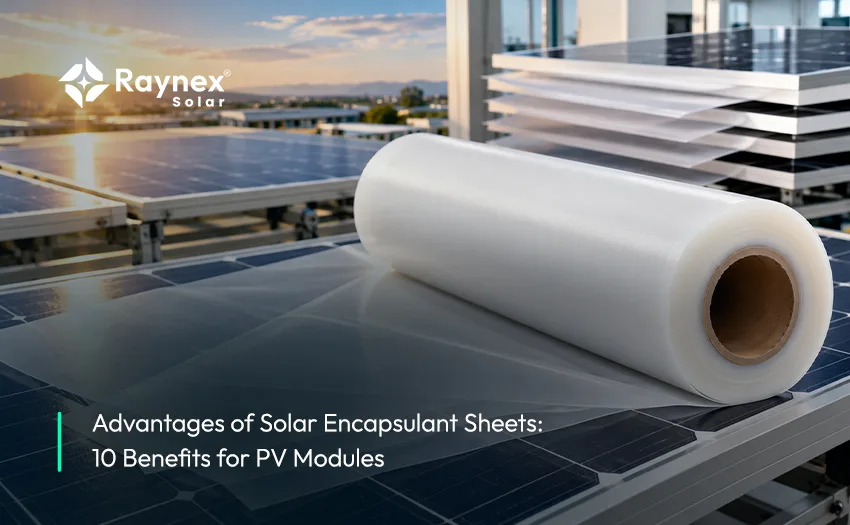
Solar encapsulant sheets play a key role in protecting photovoltaic (PV) modules and supporting long-term performance. These polymer films sit between the solar cells and other module layers, such as the front glass and backsheet or rear glass. They help hold the module together while protecting sensitive cells from moisture, heat, UV exposure, and mechanical stress.
Understanding the advantages of solar encapsulant sheet materials helps PV module manufacturers select the right film for their product requirements. EVA, POE, and EPE each offer different material properties, so the best choice depends on module structure, operating conditions, lamination settings, and cost targets.
In this guide, we explain 10 benefits of solar encapsulant sheets and how material selection can affect PV module reliability.
A solar encapsulant sheet is a polymer film used to enclose and protect solar cells inside a PV module. During lamination, the film softens and bonds with nearby module layers. After the required curing or bonding process, it helps secure the cells and forms a protective barrier around them.
The film must meet several requirements, including optical clarity, adhesion, electrical insulation, moisture resistance, and stability under heat and UV exposure. Its performance depends on the base polymer, additives, thickness, crosslinking process, and compatibility with other module materials.
The three common options are:
Learn more about Raynex Solar encapsulant products.
Moisture can enter a PV module through its edges and other pathways. Over time, water exposure may affect cell connections, metal contacts, adhesion, and other materials inside the laminate. A suitable encapsulant helps limit moisture movement and protects sensitive module components.
POE-based films are often chosen for applications that require a low water vapour transmission rate. EPE combines a POE core with EVA outer layers, offering a material option for manufacturers who need both moisture protection and adhesion.
The actual level of protection depends on the film formulation, module edge sealing, glass and backsheet choices, and the quality of lamination.
Solar cells operate within an electrical system exposed to changing temperatures, humidity, and outdoor conditions. The encapsulant provides electrical insulation between the cells and surrounding module materials. Suitable electrical properties help limit leakage current and support safe module operation.
Volume resistivity and dielectric strength are important parameters during material selection. POE is often considered for modules that require higher electrical resistance, while EVA remains widely used in many standard module designs.
Manufacturers should evaluate encapsulant performance alongside the module’s voltage rating, cell technology, glass configuration, and applicable reliability tests.
Potential-induced degradation, commonly called PID, can occur when electrical potential, moisture, temperature, and material properties interact within a PV module. It may reduce module output over time.
Encapsulant selection can affect PID resistance. POE and EPE films are often considered for module designs that require stronger resistance to this type of degradation because their material properties can help limit leakage-current pathways.
However, no encapsulant should be treated as a complete guarantee against PID. Module design, cell structure, glass, frame, system voltage, and manufacturing quality also affect the outcome. Testing the complete module is essential.
Sunlight must pass through the front glass and encapsulant before reaching the solar cells. A film with suitable optical transmission allows more incoming light to reach the active cell area.
High transparency is therefore an important solar module encapsulant property. It can support module output when combined with suitable glass, cell design, and other optical materials.
Manufacturers should review light-transmittance data for the selected film and test the complete module structure. Optical performance can change with formulation, film thickness, ageing, and exposure conditions.
A PV module contains several layers that must remain bonded during transport, installation, and years of outdoor exposure. The encapsulant helps bond the solar cells to the front glass and rear protective layer or glass.
Good adhesion helps reduce air gaps and supports resistance to delamination. Poor bonding may allow moisture pathways to form and can affect the module’s appearance and reliability.
Adhesion depends on the encapsulant formulation, surface condition, lamination temperature, vacuum, curing time, and compatibility with the selected materials. Manufacturers should verify peel strength and inspect finished laminates as part of quality control.
Solar modules experience mechanical stress during handling, transport, installation, wind loading, and temperature changes. The encapsulant holds the cells in place and helps distribute some of these stresses through the laminate.
A suitable film can help reduce the risk of cell movement and support protection against mechanical damage. This is relevant for modules used in rooftop systems, utility-scale installations, and other applications exposed to changing outdoor conditions.
Encapsulant sheets cannot prevent every crack or mechanical failure. Cell handling, interconnection design, glass strength, module construction, and transport procedures remain important parts of damage prevention.
PV modules operate outdoors and receive long periods of sunlight. Their materials must tolerate elevated temperatures, UV radiation, and repeated heating and cooling.
Solar encapsulant films contain formulations selected for the expected operating conditions. Appropriate stabilisers and additives help the film retain its required optical, mechanical, and bonding properties during exposure.
EVA, POE, and EPE formulations may respond differently to ageing conditions. Manufacturers should review the technical data sheet and test results for the specific grade rather than assuming all films of the same polymer type perform alike.
Delamination occurs when module layers lose adhesion. It may affect the module’s appearance and can create pathways for moisture or other environmental agents. Encapsulant quality and correct lamination settings are both important for limiting this defect.
A well-matched film helps maintain bonding between glass, cells, and the rear layer. Correct film storage, clean surfaces, suitable vacuum levels, and validated lamination cycles also support consistent results.
Manufacturers should monitor peel strength, visual defects, curing or crosslinking levels, and laminate quality during production. Material selection and process control must work together.
Different module designs may require different encapsulant properties. Standard modules, bifacial modules, glass-to-glass structures, and high-voltage systems can have different requirements for moisture control, electrical insulation, adhesion, and optical performance.
EVA can be a practical option for many standard module designs. POE may suit applications that need a low moisture transmission rate and higher electrical resistance. EPE combines EVA outer layers with a POE core to balance adhesion and barrier properties.
| Encapsulant type | Main material features | Common selection considerations |
|---|---|---|
| EVA | Optical clarity, flexibility, and adhesion | Standard module designs and cost targets |
| POE | Low moisture transmission and high electrical resistivity | Bifacial, glass-to-glass, and PID-sensitive designs |
| EPE | EVA outer layers with a POE core | Designs seeking a balance of adhesion and moisture protection |
The table provides general guidance, not a guarantee for every formulation. Manufacturers should compare product specifications, processing needs, compatibility, and test results before choosing a film.
Read more about Solar EVA Encapsulant, Solar POE Encapsulant, and Solar EPE Encapsulant.
PV modules are expected to operate outdoors for many years. Their long-term reliability depends on the combined performance of the cells, glass, encapsulant, backsheet or rear glass, interconnections, frame, and sealants.
The encapsulant supports this reliability by bonding module layers and helping protect cells from environmental stress. Suitable optical, electrical, and mechanical properties can help reduce the risk of specific failure modes when matched with a well-tested module design.
For manufacturers, material consistency is also important. Uniform thickness, stable processing behaviour, reliable adhesion, and batch-to-batch quality checks can support repeatable production results.
The benefits of solar encapsulant sheets depend on the material properties and how the film behaves during lamination and outdoor exposure.
| Property | Why it matters | What manufacturers should check |
|---|---|---|
| Light transmittance | Helps sunlight reach the cells | Optical data and aged-film performance |
| Adhesion strength | Keeps module layers bonded | Peel strength and material compatibility |
| Moisture transmission | Helps limit moisture entry | Water vapour transmission data |
| Electrical resistivity | Supports electrical insulation | Resistivity and relevant module tests |
| UV resistance | Helps limit ageing from sunlight | UV exposure test results |
| Thermal stability | Supports use across temperature changes | Thermal and damp-heat test results |
| Crosslinking or curing | Affects film structure and bonding | Gel content or suitable process checks |
| PID resistance | Helps manage a specific degradation risk | Tests on the complete module design |
These properties should be reviewed together. A film with strong moisture resistance may still require process adjustments or compatibility checks to achieve the required adhesion. Likewise, high optical transmission alone does not confirm long-term module reliability.
PV module manufacturers should consider the full module design and production process before selecting an encapsulant.
1. Define the module application. Identify the cell technology, module structure, system voltage, and expected operating conditions.
2. Compare EVA, POE, and EPE. Review optical transmission, adhesion, electrical properties, moisture transmission, UV stability, and cost.
3. Check lamination compatibility. Confirm that the film works with the manufacturer’s equipment, cycle time, temperature, and vacuum settings.
4. Review technical documents. Request the product data sheet, quality specifications, storage instructions, and relevant test reports.
5. Validate the complete module. Conduct suitable reliability and environmental tests on the final laminate rather than relying only on individual film data.
6. Check consistency between batches. Monitor thickness, appearance, adhesion, curing or crosslinking, and other agreed quality parameters.
This process helps manufacturers match material performance with production needs and the intended service conditions of the PV module.
Working directly with a solar encapsulant sheet manufacturer in India can help module makers discuss material specifications, supply requirements, and technical support with the source. Manufacturers should assess quality controls, product consistency, documentation, lead times, and the supplier’s ability to meet agreed specifications.
Raynex Solar supplies EVA, POE, and EPE encapsulant sheets for PV module manufacturing. Its product range supports different module requirements, including applications where optical clarity, adhesion, moisture control, and electrical properties are key selection factors.
Explore the Raynex Solar product range or contact the team at info@raynexsolar.com to discuss your module requirements.
Solar encapsulant sheets support PV module reliability by protecting cells, bonding module layers, allowing light transmission, and helping manage moisture, electrical, thermal, and mechanical stress. EVA, POE, and EPE each offer different properties, so material selection should follow the requirements of the complete module.
For PV module manufacturers, reviewing technical data, validating lamination settings, and testing the finished module are key steps in choosing a suitable film. Raynex Solar offers EVA, POE, and EPE encapsulant sheets for manufacturers seeking materials matched to their module specifications.
The main advantages include solar cell protection, electrical insulation, light transmission, adhesion between module layers, moisture control, and support for long-term reliability. The level of each benefit depends on the film formulation and module design.
EVA is widely used for its clarity and adhesion. POE is often selected for its low moisture transmission and electrical properties. EPE has an EVA-POE-EVA structure that combines EVA outer layers with a POE core.
Encapsulant films help limit moisture movement into the module and surround the cells within the laminate. The level of protection also depends on edge sealing, glass, backsheet or rear glass, and manufacturing quality.
An appropriate encapsulant can help reduce PID risk, but it cannot guarantee that PID will not occur. Cell technology, module construction, system voltage, moisture, and other materials also affect the result.
Adhesion helps hold the module layers together. Poor adhesion can lead to delamination, which may affect appearance and create pathways for moisture. Correct material selection and lamination control are both necessary.
Manufacturers should review optical transmission, adhesion, moisture transmission, electrical resistivity, UV and thermal stability, processing requirements, storage conditions, and relevant test results. They should also confirm compatibility with the complete module design.
EPE may be suitable for bifacial modules, depending on the module design and the selected film’s optical, electrical, and moisture-barrier properties. Manufacturers should confirm rear-side optical requirements and validate the finished module through suitable testing.
For crosslinkable EVA formulations, the curing process affects the film’s final structure, adhesion, and mechanical behaviour. Manufacturers should use the supplier’s validated lamination settings and monitor suitable process indicators, such as gel content where applicable.