

Bifacial solar panels are changing the energy market in India. Unlike regular panels, they catch light from both the front and the back. High-quality Encapsulants Reduce O&M costs by protecting solar cells from moisture, PID, UV stress, and internal degradation.
Bifacial solar panels are often installed on surfaces that reflect light, like white roofs or sandy ground. This extra light creates more heat and energy inside the module. Because they have glass on both sides, the materials inside must be strong.
Without strong protection, the delicate solar cells can suffer from moisture or chemical changes. In India’s hot and humid climate, these panels need to stay sealed perfectly for 25 years. If the seal fails, the cost of fixing the plant goes up quickly. Choosing high-quality encapsulants early helps support bifacial solar maintenance cost reduction over the long term.
Operation and Maintenance (O&M) is one of the biggest expenses for any solar farm. In bifacial plants, engineers face unique problems. Common issues include PID (Potential Induced Degradation) and the peeling of internal layers. These problems force technicians to visit the site more often, which increases solar plant O&M budgets in India in 2026.
Another challenge is encapsulant degradation bifacial modules face due to UV light exposure on both sides. If the material yellows or cracks, it blocks light from reaching the cells. This reduces the energy the plant makes. To avoid these expensive headaches, owners are now focusing on how Solar encapsulants Protect Solar panels from the inside out.
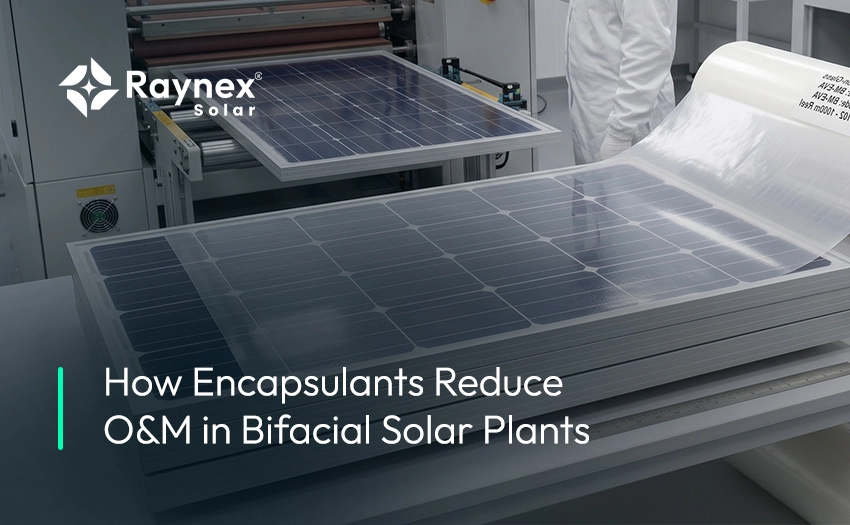
Think of an encapsulant as the ‘glue’ and ‘shield’ for a solar panel. It is a thin sheet of polymer that wraps around the solar cells. Its main job is to provide structural support and protect the cells from weather, dirt, and moisture. Without this layer, the cells would break or corrode almost instantly when placed outdoors.
There are different types of materials used today, including EVA, POE, and EPE. Each has different strengths. While EVA has been used for decades, newer technologies like POE are becoming the standard for bifacial modules. These materials ensure that electricity stays where it belongs and that the panel remains clear so light can pass through easily.
When comparing materials, the POE vs EVA O&M costs show a clear winner for bifacial technology. Solar EVA Encapsulant is cheaper to buy, but it can release acetic acid over time. This acid eats away at the solar cells. POE (Polyolefin Elastomer) is chemically stable and does not produce acid, making it much safer for high-performance plants.
| Feature | EVA Encapsulant | POE Encapsulant |
|---|---|---|
| Water Vapor Barrier | Moderate | Excellent |
| Chemical Stability | Low (Can form acid) | High |
| PID Resistance | Average | Superior |
| Best For | Monofacial Panels | Bifacial & Glass-Glass |
One of the best ways to save money is by reducing O&M costs solar plants face due to PID. PID happens when electricity leaks through the glass to the frame. This can kill a panel’s output by 30% or more. High-quality POE encapsulants bifacial solar systems use have much higher electrical resistance, which stops this leakage entirely.
Understanding how encapsulants prevent PID and delamination in bifacial modules is vital for site owners. Delamination is when the layers of the panel start to peel apart. This lets in water and air. Premium materials stick better to the glass and cells, preventing these gaps and the micro-cracks that lead to dead spots on the panel.
India has heavy monsoons and intense sun. Premium encapsulants act as a waterproof barrier. By keeping moisture out, they prevent the metal parts of the cell from rusting. They also resist UV damage, ensuring the panel stays transparent for its entire life.
Using the right material is how premium POE encapsulants significantly reduce Operation & Maintenance (O&M) costs in bifacial solar plants. When the internal parts stay healthy, the whole system lasts longer. This means you don’t have to replace modules early, which is the most expensive part of O&M.
By choosing better encapsulants, the Levelized Cost of Energy (LCOE) drops. Even if the panels cost 1-2% more at the start, the savings in O&M are huge. You spend less on testing, less on replacing failed modules, and your plant generates more kilowatt-hours every year. Over 25 years, this can save a large-scale developer millions of rupees.
In India, projects in Rajasthan or Gujarat face extreme heat. Standard EVA can fail quickly here. Projects using POE have shown much steadier performance. As the industry moves toward solar plant O&M India 2026 goals, using durable materials is the only way to meet the high-reliability standards required by the government and investors.
At Raynex solar, we help clients choose components that last. We understand that the cheapest upfront price is often the most expensive in the long run. We recommend POE or EPE (a mix of both) for bifacial projects because they provide the best balance of cost and protection. Our goal is to ensure your investment stays profitable without constant repairs.
Choosing the right protective layer is the most effective way to ensure Encapsulants Reduce O&M expenses. By preventing PID, moisture damage, and peeling, materials like POE keep bifacial plants running at peak power. As India grows its solar capacity, focusing on these small details will lead to a more stable and profitable green energy future.
POE is preferred because it has a better water barrier and does not create acid. Bifacial modules have glass on both sides, and POE prevents PID and moisture damage much better than EVA.
Yes. By preventing major issues like PID and delamination, premium encapsulants reduce the need for panel replacements and frequent technical inspections, lowering overall maintenance spend.
Absolutely. High-quality encapsulants protect the solar cells from UV light and moisture, which are the main causes of panel aging. This ensures the system lasts for its full 25-30 year rating.
Yes, because glass-glass modules trap moisture more easily if it gets inside. Using a high-quality material like POE ensures that moisture stays out and the layers stay bonded together.
Yes. Investors and insurance companies look for high-quality components. Using proven materials like POE makes a solar plant more reliable and easier to fund or insure.