
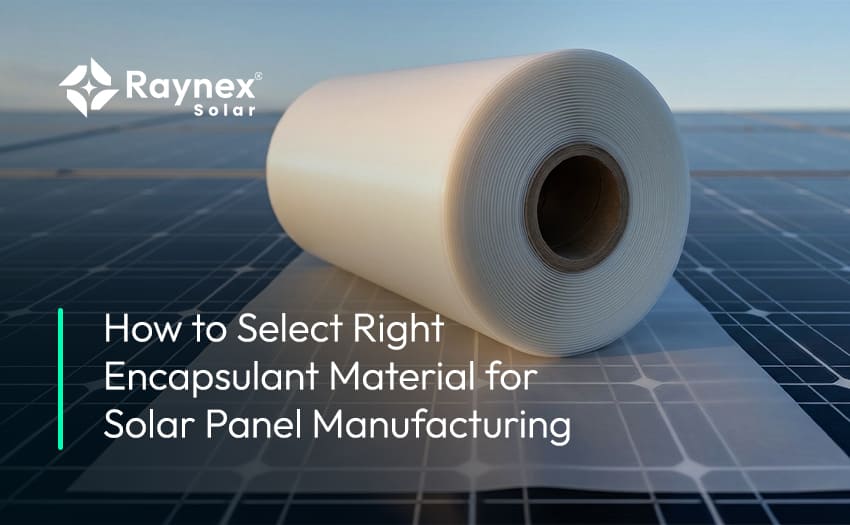
Selecting the correct encapsulation material is one of the most critical decisions in solar module manufacturing. Encapsulants protect delicate solar cells from environmental damage while ensuring long-term module performance. A poor encapsulation choice can lead to reduced efficiency, reliability issues, and shortened module lifespan. For manufacturers, understanding the criteria behind solar encapsulant selection is essential for producing durable and high-performance photovoltaic modules. In this article, we will explore how manufacturers evaluate solar module encapsulant material, the key factors to consider, and how the right material improves solar panel reliability.
In a solar panel, the encapsulant sits above and below the solar cells, bonding the module layers together during the lamination process. This layer protects the cells from environmental exposure and mechanical stress while allowing sunlight to pass through efficiently.
The primary functions of a solar module encapsulant material include:
Because encapsulants directly influence the reliability of solar panels, careful solar encapsulant selection is necessary during module design.
Choosing the right encapsulation material requires evaluating several technical and environmental parameters.
Optical Transparency
Encapsulation materials must allow maximum sunlight to reach the solar cells. High optical transmission improves energy output and overall module efficiency. A good solar module encapsulant material should maintain transparency throughout the module’s lifespan without discoloration.
Moisture Resistance
Moisture penetration is one of the most common causes of solar module degradation. The encapsulant must provide strong resistance against water vapor transmission to prevent corrosion and electrical failures.
Materials with lower moisture permeability help improve long-term reliability.
Adhesion Strength
Strong bonding between the glass, solar cells, and backsheet is critical for structural stability. Poor adhesion can lead to delamination and other mechanical failures. A reliable encapsulant must maintain strong adhesion even under high temperature and humidity conditions.
Electrical Insulation
Encapsulation materials must provide proper electrical insulation to prevent leakage currents and electrical degradation. High insulation properties also reduce the risk of issues such as potential-induced degradation (PID).
UV and Thermal Stability
Solar panels operate in environments with continuous exposure to sunlight and high temperatures. The encapsulant must be resistant to ultraviolet radiation and thermal stress to maintain its physical and optical properties over time.
Manufacturers typically choose from several types of encapsulation materials depending on the module design and environmental requirements.
EVA (Ethylene Vinyl Acetate) – EVA has been the industry standard encapsulation material for many years due to its good transparency, strong adhesion, and cost efficiency. It is widely used in conventional solar modules.
POE (Polyolefin Elastomer) – POE encapsulants offer better resistance to moisture and electrical degradation. They are often used in high-efficiency modules and bifacial solar panels.
EPE (EVA-POE-EVA) – EPE encapsulants combine the advantages of EVA and POE in a multi-layer structure. This design provides improved moisture resistance while maintaining strong adhesion and good optical performance.
The choice among these materials depends on performance requirements, manufacturing processes, and cost considerations.
Solar panels are installed in a wide range of environmental conditions, from desert regions to coastal areas with high humidity. The environmental conditions where the modules will operate should influence solar encapsulant selection.
For example:
Selecting the appropriate solar module encapsulant material based on installation conditions helps ensure long-term system reliability.
Encapsulation materials directly influence several key aspects of solar module performance:
A well-chosen encapsulation material helps solar modules maintain consistent performance over decades of operation.
Another important factor in solar encapsulant selection is compatibility with the manufacturing process. Encapsulation materials must work efficiently with lamination temperatures, production speeds, and module designs used by manufacturers. Factors such as curing time, lamination temperature, and crosslinking properties can affect production efficiency and module quality. Manufacturers must ensure that the selected solar module encapsulant material integrates smoothly with their manufacturing process.
At Raynex Solar Pvt. Ltd., we understand that the reliability of solar modules depends heavily on the quality of encapsulation materials. Our focus is on developing high-performance encapsulant solutions designed to support modern solar module manufacturing. By combining advanced polymer technology with precision manufacturing, Raynex Solar Pvt. Ltd. aims to provide encapsulation materials that offer strong adhesion, excellent transparency, and reliable environmental protection. Our goal is to help solar manufacturers produce durable and high-efficiency modules capable of delivering clean energy for decades.
Selecting the right encapsulation material is a crucial step in solar module manufacturing. Careful solar encapsulant selection ensures that solar panels remain reliable, efficient, and durable throughout their operational life. Factors such as optical transparency, moisture resistance, adhesion strength, electrical insulation, and environmental stability all play important roles in choosing the right solar module encapsulant material. As solar technology continues to evolve, advanced encapsulation materials will remain essential for improving module performance and supporting the long-term growth of the solar industry.
An encapsulant is a protective polymer layer used in solar panels to seal and protect photovoltaic (PV) cells from moisture, UV radiation, mechanical stress, and environmental damage. It ensures electrical insulation, structural stability, and long-term performance of the solar module.
Choosing the correct encapsulant material directly affects the durability, efficiency, and lifespan of a solar module. A high-quality encapsulant prevents cell degradation, improves light transmission, enhances adhesion between layers, and protects the module from environmental damage.
Encapsulant materials with high light transmission allow more sunlight to reach the photovoltaic cells, improving energy conversion efficiency. Poor-quality encapsulants may yellow or degrade over time, reducing light transmission and lowering solar panel output.
Yes. High-quality encapsulants can extend the lifespan of solar panels to 25–30 years or more by preventing moisture ingress, protecting cells from UV damage, and maintaining structural integrity throughout the module’s lifecycle.
EVA encapsulants are widely used because they are cost-effective and easy to process. However, POE encapsulants provide better resistance to moisture, potential-induced degradation (PID), and long-term performance. POE is often preferred for high-efficiency or bifacial solar modules.