
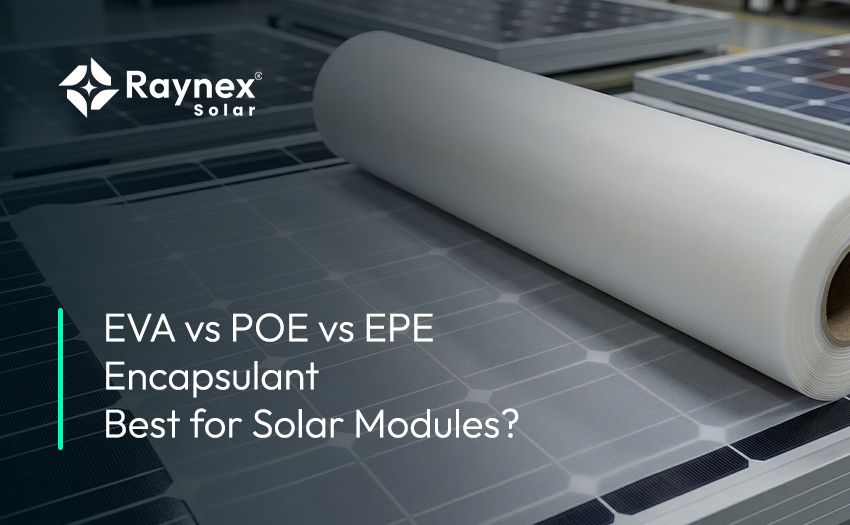
In the solar manufacturing industry, the reliability and efficiency of a solar module depend not only on solar cells but also on the materials used to protect them. One of the most critical components inside a photovoltaic module is the encapsulation layer, which safeguards the solar cells from environmental damage, moisture, and electrical degradation. Today, manufacturers have multiple encapsulation options available, including EVA, POE, and EPE encapsulants. Understanding the differences between these materials is essential for selecting the right solution for solar module manufacturing. In this article, we will explore EVA vs POE vs EPE encapsulant, compare their performance, and understand which option is best for modern solar modules.
A solar encapsulant is a protective polymer sheet placed above and below the solar cells within a solar module. During the lamination process, the encapsulant melts and bonds the module layers together, forming a protective seal.
The primary functions of a solar encapsulant include:
Because of these critical functions, choosing the right encapsulation material is a key decision in solar module manufacturing.
The most commonly used solar module encapsulation materials today include:
Each material offers unique advantages and is suitable for different solar module technologies.
EVA has been the most widely used encapsulation material in the solar industry for many years. It offers good transparency, strong adhesion, and cost efficiency, which made it the industry standard during the early growth of solar manufacturing.
Advantages of EVA encapsulant:
However, EVA also has certain limitations. It can allow higher moisture permeability and may be more susceptible to Potential Induced Degradation (PID) in certain environmental conditions. This has encouraged manufacturers to explore improved encapsulation materials.
POE encapsulants have been developed to address some of the limitations of traditional EVA materials. POE offers superior moisture resistance and excellent electrical insulation properties.
Advantages of POE encapsulant:
However, POE materials typically cost more than EVA and may require careful processing during module lamination. Adhesion properties can also be slightly more complex compared to EVA.
EPE encapsulants are multi-layer sheets designed to combine the advantages of both EVA and POE. The structure typically consists of three layers:
This design allows EPE encapsulants to benefit from the strong adhesion and transparency of EVA while gaining the moisture resistance and PID protection offered by POE.
Advantages of EPE encapsulant:
Because of these benefits, EPE encapsulants are becoming increasingly popular in modern solar module manufacturing.
To better understand the differences between these materials, it is helpful to compare their key characteristics.
| Property | EVA Encapsulant | POE Encapsulant | EPE Encapsulant |
|---|---|---|---|
| Optical Transparency | High | High | High |
| Moisture Resistance | Moderate | Excellent | Very Good |
| PID Resistance | Moderate | Excellent | Very Good |
| Adhesion Strength | Excellent | Moderate | Excellent |
| Cost | Low | High | Medium |
| Industry Adoption | Very High | Increasing | Rapidly Growing |
This solar encapsulant comparison shows that each material serves a specific purpose depending on performance requirements and budget considerations.
The answer depends on the type of solar module being manufactured and the environmental conditions where the module will be installed.
As solar technology evolves, the demand for more reliable solar module encapsulation materials continues to grow. High-efficiency solar cells, bifacial modules, and large-scale solar installations require encapsulation materials that provide long-term durability and electrical stability. Innovative encapsulation technologies are helping manufacturers improve module performance while reducing long-term degradation risks.
At Raynex Solar Pvt. Ltd., we focus on developing high-quality encapsulation solutions designed to meet the evolving needs of the solar manufacturing industry. Our encapsulant materials are engineered to provide strong adhesion, high transparency, and reliable protection for solar cells. By combining advanced material science with modern manufacturing processes, Raynex Solar Pvt. Ltd. aims to support solar module manufacturers with reliable encapsulation materials that contribute to long-lasting photovoltaic systems.
Understanding EVA vs POE vs EPE encapsulant is essential for selecting the right encapsulation solution in solar module manufacturing. Each material offers unique benefits in terms of cost, durability, and performance. While EVA remains widely used, POE and EPE encapsulants are gaining popularity due to their improved moisture resistance and PID protection. As the solar industry continues to advance, choosing the right solar module encapsulation materials will play a key role in ensuring long-term efficiency and reliability. Manufacturers who adopt advanced encapsulation technologies will be better positioned to deliver durable and high-performance solar modules for the growing renewable energy market.
An encapsulant is a protective polymer layer used inside solar panels to bond and protect solar cells. It shields the cells from moisture, UV radiation, mechanical stress, and environmental damage, ensuring long-term performance and durability of the module.
EVA (Ethylene Vinyl Acetate) is the most widely used encapsulant material in solar modules. It provides good transparency, adhesion, and electrical insulation, making it a cost-effective solution for many standard solar panels. However, EVA has higher moisture permeability, which can sometimes lead to potential induced degradation (PID) in certain environments.
POE (Polyolefin Elastomer) is an advanced encapsulant material known for its excellent moisture barrier properties and higher electrical insulation compared to EVA. POE is often used in high-efficiency modules, bifacial panels, and modules deployed in high-humidity environments.
EPE (EVA-POE-EVA) is a multilayer encapsulant structure combining EVA and POE materials. The POE layer provides improved moisture resistance, while the EVA layers offer strong adhesion and easier processing, making EPE a balanced and cost-effective encapsulation solution.
Yes, EPE encapsulant is often considered an improved alternative to EVA because it combines EVA’s processability with POE’s moisture resistance, offering better long-term performance for modern solar modules.