
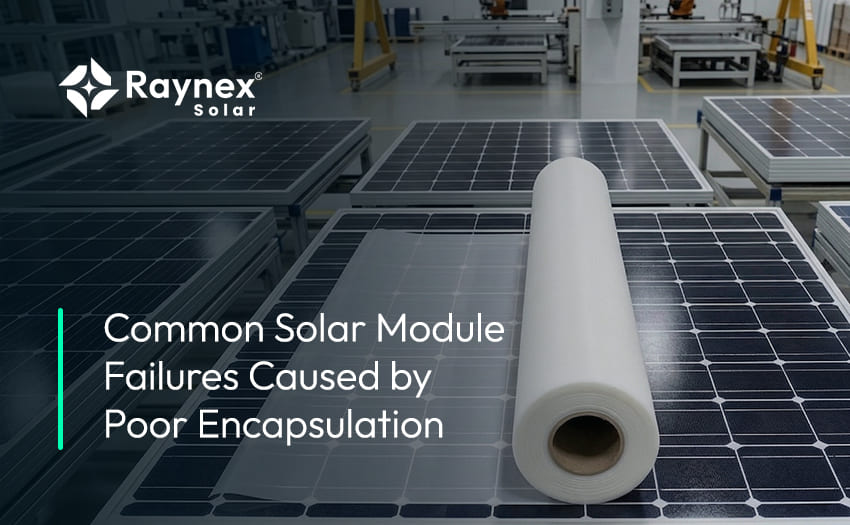
Solar panels are designed to operate reliably for 25 years or more. However, the long-term performance of a solar module does not depend only on solar cells or module design. One of the most critical factors that determines the durability of a solar panel is the quality of its encapsulation system. When the encapsulation layer is poorly designed or manufactured with low-quality materials, it can lead to several reliability issues inside the solar module. These failures can reduce energy output, damage internal components, and shorten the lifespan of the solar panel. In this article, we will explore the most common solar module encapsulation problems and understand how issues such as solar panel delamination and other defects occur due to poor encapsulation.
Encapsulation is the process of sealing solar cells inside protective polymer layers during module manufacturing. These encapsulation layers sit between the solar cells and the outer structural components such as the glass and backsheet. The main purpose of encapsulation is to:
If the encapsulation material or the lamination process is not properly controlled, several solar module encapsulation problems can occur.
One of the most serious issues caused by poor encapsulation is solar panel delamination.
Delamination occurs when the bond between different layers of the solar module begins to separate. This separation usually happens between the glass, encapsulant, solar cells, or backsheet.
Common causes of solar panel delamination include:
When delamination occurs, air or moisture can enter the module structure, which can damage solar cells and electrical connections. Over time, this can significantly reduce the performance and reliability of the solar panel.
Moisture penetration is another major problem related to poor encapsulation. If the encapsulation material does not provide adequate moisture resistance, water vapor can slowly enter the module.
This moisture can cause:
Moisture-related solar module encapsulation problems are particularly common in regions with high humidity or coastal environments.
Encapsulation materials are exposed to continuous ultraviolet radiation from sunlight. If the material does not have strong UV resistance, it may begin to discolor or yellow over time. Yellowing of the encapsulant reduces the amount of sunlight reaching the solar cells, which directly affects the energy output of the solar panel. This problem is often associated with lower-quality encapsulation materials or improper material formulations.
Another reliability issue linked to poor encapsulation is Potential Induced Degradation (PID). PID occurs when electrical leakage currents develop within the solar module due to differences in electrical potential. Certain encapsulation materials may allow higher electrical conductivity or moisture penetration, which increases the risk of PID. PID can significantly reduce the power output of a solar module and may cause long-term performance losses.
During the lamination process, air bubbles or voids may form within the encapsulation layers if the process parameters are not properly controlled. These bubbles can weaken the bonding between layers and create pathways for moisture to enter the module. Over time, bubble formation can contribute to solar module encapsulation problems and accelerate module degradation.
Poor encapsulation can affect solar modules in several ways, including:
Problems such as solar panel delamination, corrosion, and encapsulant degradation can significantly impact the performance of a solar installation.
To avoid these failures, manufacturers must use high-quality encapsulation materials and maintain strict process control during module lamination.
Key factors that improve encapsulation reliability include:
Advanced encapsulation materials such as EVA, POE, and EPE are designed to improve long-term module reliability when used with proper manufacturing processes.
At Raynex Solar Pvt. Ltd., we recognize the importance of reliable encapsulation in solar module manufacturing. High-quality encapsulation materials play a crucial role in preventing common solar module encapsulation problems such as solar panel delamination and moisture-related degradation. Our focus is on developing encapsulation materials that provide strong adhesion, high transparency, and improved resistance to environmental stress. By combining advanced material science with modern manufacturing processes, Raynex Solar Pvt. Ltd. aims to support solar manufacturers in producing durable and high-performance solar modules.
Encapsulation is one of the most critical elements in solar module design. Poor encapsulation can lead to several reliability issues, including solar panel delamination, moisture ingress, yellowing, and electrical degradation. Understanding these solar module encapsulation problems helps manufacturers improve material selection and manufacturing processes to produce more reliable solar panels. As solar technology continues to evolve, high-quality encapsulation materials will remain essential for ensuring long-term module durability and stable energy production.
Encapsulation in a solar module refers to the protective layer, usually made of EVA (Ethylene Vinyl Acetate) or similar materials, that seals the solar cells between the glass and backsheet. This layer protects the cells from moisture, dust, mechanical stress, and environmental degradation while maintaining electrical insulation.
Poor encapsulation can allow moisture, air, and contaminants to enter the solar module. This can lead to cell corrosion, delamination, discoloration, electrical leakage, and reduced power output, ultimately shortening the module’s lifespan.
The most common failures include delamination, yellowing or browning of the encapsulant, moisture ingress, corrosion of solar cells, snail trails, and hot spots. These issues reduce module efficiency and may cause permanent damage to the solar panel.
Manufacturers can prevent encapsulation failures by using high-quality encapsulant materials, maintaining strict lamination process controls, performing durability testing, and following international standards such as IEC certification for module reliability.
In most cases, encapsulation issues such as delamination or moisture ingress cannot be repaired effectively. The affected solar modules usually need to be replaced to maintain system safety and performance.