

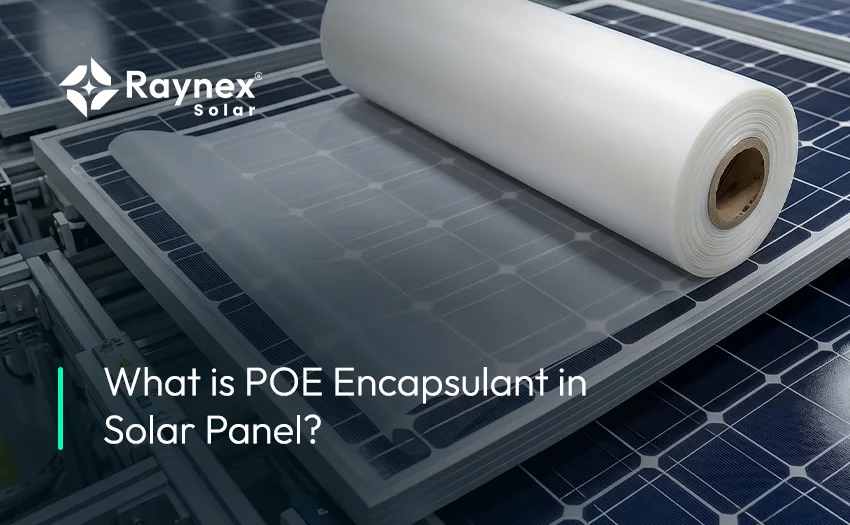
All solar panels come with a layer that protects the solar cells and enables the solar panel to survive in perfect working condition for a long time. This layer is known as an encapsulant. Among the multiple types of encapsulants, POE (Polyolefin Elastomer) has become a popular choice because it offers excellent protection against moisture, heat, and UV rays.
In this blog, you will get to know about POE encapsulant, what it is, & how it works.
POE full form in solar is Polyolefin Elastomer.
POE encapsulant is the protective material used inside photovoltaic (PV) solar panels. It works by protecting solar cells from moisture, heat, dust, and other elements that can harm. This protective layer helps the solar cells work efficiently and improves the overall performance and lifespan of the solar panel.
Currently, POE encapsulant is mostly used in advanced solar modules, especially N-Type TOPCon Modules and bifacial solar panels, because it offers better protection and long-term reliability than many traditional encapsulant materials.
POE encapsulant surrounds the solar cells in the module and forms a strong protective layer during the lamination process. When heat and pressure are applied, the POE film melts and flows around the solar cells. It bonds them securely to the glass and backsheet or second glass.
After cooling, it becomes a durable, transparent layer. This layer keeps the cells firmly in place while allowing sunlight to pass through. Its low moisture permeability and high electrical insulation protect the cells from water ingress, PID (Potential Induced Degradation), and environmental damage. This improves the long-term performance and reliability of the solar module.
Here are some advantages of using POE Encapsulant:
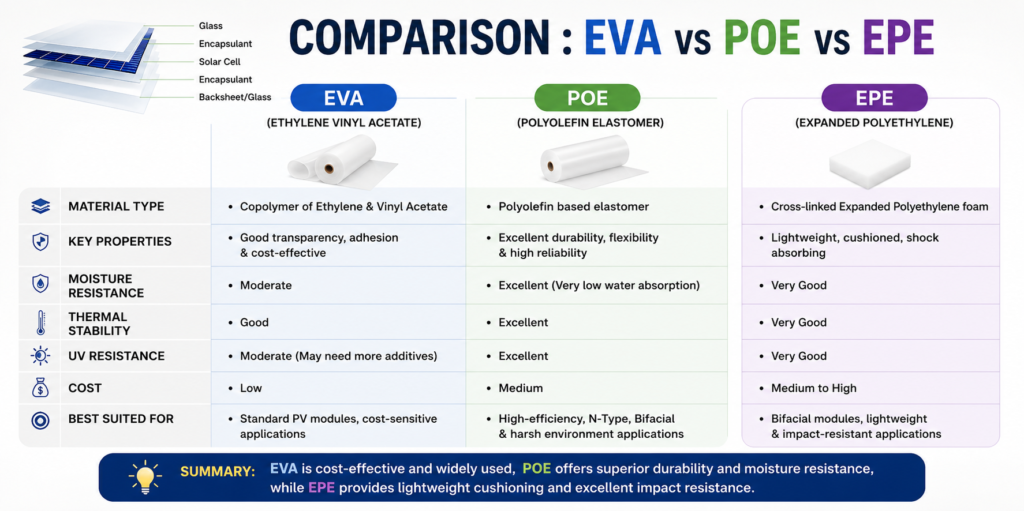
POE encapsulant offers great protection against moisture. It has a much lower water vapor transmission rate (WVTR) than EVA. This means that less moisture can pass through the encapsulant and reach the solar cells. As a result, there is a reduced risk of corrosion, performance loss, and long-term damage. Due to this strong moisture resistance, It is a dependable option for high-efficiency and moisture-sensitive solar modules. It helps these modules perform better for many years.
PID is a common problem where stray electricity leaks out of the solar cells, causing them to lose power. This usually happens in hot and wet weather. Because It is a great insulator, it stops this electricity from leaking. This ensures your panels keep producing the maximum amount of power year after year.
Most people expect their solar panels to last for 30 years. Using POE helps reach this goal. It does not get brittle or crack over time. By keeping the cells safe from the outside world, it helps the whole system stay in good shape for a much longer time than panels made with cheaper materials.
Older encapsulants like EVA encapsulant can sometimes create acetic acid (which is like vinegar) when they get wet and hot. This acid eats away at the solar cells and the thin wires. POE is chemically stable and does not create any acid. This means your solar cells stay clean and shiny for their whole life.
For a solar panel to work, light needs to reach the cells. It is incredibly clear and allows almost all sunlight to pass through it. Unlike some plastics that turn cloudy or yellow after being in the sun, it stays crystal clear. This means more sunlight turns into electricity for your home or business.
Modern solar technology, like the n-type TOPCon modules, needs special care. These cells have sensitive coatings that can be easily damaged by chemicals. Because It is neutral and tough, it is the best partner for these high-efficiency cells, helping them work at their best without any interference.
When big companies build massive solar farms, they want the best parts. They know that a small failure can cost a lot of money. They trust POE in solar because it has been tested in extreme conditions. It is the go-to choice for any project where reliability is more important than saving a few pennies on materials.
Many modern panels use glass on the front and the back instead of a plastic backsheet. This “double-glass” design is very heavy and gets very hot. POE works perfectly with glass because it bonds strongly to it. It acts as a cushion that prevents the glass from breaking during heavy winds or snow.
Solar panels sit in the baking sun all day. UV rays can destroy many types of plastic, making them fall apart. It is naturally resistant to UV light. It can handle high heat and intense sunshine for thirty years without losing its strength or its ability to protect the cells.
Whether it is the freezing cold of a snowy winter or the burning heat of a desert, POE stays flexible. Some materials become hard and crack when it gets too cold, but this elastomer stays rubbery. This flexibility protects the fragile silicon cells from snapping when the panel expands or contracts.
Using these films can actually make the factory work better. They often require a shorter time in the laminator machine compared to older materials. This saves energy during the making of the panel. It is a win-win for the environment because we use less energy to build the things that make clean energy.
One of the main reasons some companies still use older materials is the price. POE is more expensive to produce than EVA. This can make the final solar panel cost a little bit more. However, most experts agree that the extra cost is worth it because the panels last longer and produce more power.
Because it is a newer and more advanced material, not every factory in the world can get a steady supply. In some regions, it might be harder to find panels that use 100% POE. However, as demand grows, more suppliers are starting to offer it everywhere.
Working with this material requires better machines and more careful control of temperature. If the factory is not high-tech, they might find it difficult to use. This means you usually find this material in panels made by top-tier, high-quality brands rather than budget manufacturers.
For very basic, low-cost solar panels used for small tasks, POE might be seen as “overkill.” If a panel only needs to last 10 years, a cheaper plastic might be used. But for rooftop solar and large power plants, it has become the gold standard.
If you are looking for top-tier solar protection, Raynex Solar is a leader in the industry. They specialize in high-performance POE Encapsulant in Solar Panel products that meet global standards. Their products are designed to solve the common problems found in older panel designs, like moisture damage and PID.
At Raynex Solar, the focus is on quality and innovation. They provide specialized POE Encapsulant films that are specifically tested for the latest n-type PV modules. By choosing a manufacturer that understands the science behind the material, you ensure that your solar investment is protected by the best technology available today.
Choosing the right solar panel is about more than just the price. It is about how long that panel will work for you. The POE Encapsulant in Solar Panel technology is one of the most important upgrades in recent years. It keeps water out, stops power loss, and helps the newest types of solar cells perform at their peak.
While it might be a bit more expensive, the protection it offers for photovoltaic (PV) solar panels is unbeatable. If you are planning to go solar, look for panels that use POE. It is the best way to make sure your green energy system stays strong, clear, and powerful for many decades to come.
POE Encapsulant is a protective film made from Polyolefin Elastomer (POE) that protects solar cells from moisture, heat, UV rays, and electrical leakage while improving the lifespan of solar panels.
POE provides better moisture resistance, stronger electrical insulation, improved PID resistance, and longer-term reliability, making it ideal for advanced solar modules.
Yes, usually. The raw material costs more and requires better machines to process. However, the panels usually last longer and have better warranties, which saves money in the long run.
POE is commonly used in premium solar panels, glass-to-glass modules, bifacial panels, and advanced N-Type TOPCon Modules.
POE can be used in many solar panels, but it is especially beneficial for high-efficiency and premium modules where long-term performance and durability are top priorities.
Yes. By protecting solar cells from environmental damage and reducing long-term degradation, POE helps extend the operational life of solar panels.
Yes, it is considered more stable and does not release harmful chemicals as it ages. Also, because it makes panels last longer, it reduces waste by keeping panels out of landfills for more years.